Monday, December 16, 2013

A Clean Office is a Happy Office

Working in a Chinese company is a bit different than working in other places. This year, when I arrived at school, I was told two things: lunch would be provided to me and to bring my own dishes. The lunch thing was good news. The dishes thing was weird. I asked what they meant about my own dishes. I was then shown a large cabinet that was filled with mismatched Tupperware type containers, porcelain bowls, and chopsticks. Apparently, I was expected to bring in my own dishes and cutlery to “make sure they are clean” when I use them. So, I went to Wu Mart (a Wal-Mart type store) and bought my own Tupperware type container and travel cutlery set to bring to work with me.

At my first office lunch, I watched my coworkers carefully to see what the office etiquette was for lunch. It’s different but, straightforward. Everyone brings in their own container and cutlery. They use them daily and wash everything before putting it back into the cabinet. I, too, did this for a little while until I realized just how watered down the school provided dish soap is. Now, I bring my stuff back home each day to wash with my own, undiluted soap.

At school, we foreign teachers and our bilingual, Chinese co-teachers share an office. In October, I started to notice that the office floor looked exceptionally dirty. Then, I saw one of the Chinese co-teachers sweeping and another taking out the trash. This happened again a few weeks later. Finally, I realized that we are expected to clean our own office. I checked with the Chinese co-teachers and they confirmed it. So, now, every few weeks, I take a turn cleaning our office floor and dusting the communal surfaces with wet wipes.


Although I’ve searched around online, I can’t find how common or uncommon my school’s habits are. However, the Chinese teachers seem unfazed by everything. Therefore, I assume this is at least somewhat common in China. So, if you come here to work, bring your own dishes for lunch and be ready to sweep the office floor.

Office Supplies
__________

This looks almost exactly like my cutlery set. The chopstick pieces screw apart to make the set more portable.
__________

Like my lunch container.
__________

Monday, December 9, 2013

Lights Out!

Friday was quite a night. It started out calm and then turned into a Chinese adventure that I’d rather not repeat.

So, while watching Netflix, the electricity went out. I opened the apartment door to check and see if the lights were on in the hallway. They were. Plus, the elevator worked. I figured out that it was just my apartment that was out. Well, this could only mean one thing: we were out of electricity.

I know, that sounds weird. In Beijing, China, however, this makes sense. See, in the other places I’ve lived (the US and South Korea), you use electricity and then get a bill for the month. Not so in China. Here, you go to a bank and load up a card with money. Next, you take this card home and insert it into a card reader slot on your electrical meter. Then, your account gets recharged and you have electricity. You don’t have to wait until your electricity is used up. You can add money to your account at any time. I, however, am not used to this system and I let the balance get too low. Thus, my electricity went out on Friday.

After figuring out why my electricity was out, I took my card to a nearby Bank of Beijing branch to load money onto the card. While at the machine, I got a funny message that said “See a bank employee.” The bank was closed so, this was not possible. I ended up calling a bilingual staff member from work, Sophie, to help me. Originally, I thought the recharge machine was broken. It wasn’t. It turns out that my job forgot to give me a new electricity card. See, recently, our building got new electrical meters. We were also so supposed to get new cards. My current electricity card was useless.

Sophie suggested that I go home and either get the serial number off of my meter or get my electricity account number. She thought that with this information, she could go online and add money to the account for me. So, I trudged back home and tried to get this information.

I couldn’t get the information. Since my apartment was pitch-black, I couldn’t find my key to the meter closet. Also, since I can’t read Chinese, I couldn’t figure out which of the many bills, papers, and receipts we get was from the power company.  At this point, I thought that I would have to wait until Monday to get electricity. I decided that a weekend without power was simply not an option. I needed reinforcements. 

I called Sophie and told her that I had a plan. I was going to knock on my neighbor’s door and give him/her my phone. Then, Sophie would explain the situation, in Chinese, and see what the neighbor could do to help me.

I knocked on the apartment next door and waited. An older man answered. I said “Nihao,” and handed him my cell phone. To his credit, he looked confused but, he took the phone without hesitation. I guess Sophie explained things well because he immediately put on his shoes and got a flashlight and his meter room key.

The man, Mr. Wong, read Sophie the serial number off of the meter. Then, I gave him several utility receipts. He kindly sifted through them until he found one with the electricity account number. He also gave Sophie that number.

It turns out that Mr. Wong speaks a little English. He told me he was leaving the meter closet unlocked for me and to knock on his door if I needed more help in the future. All in all, he spent about 20 minutes helping me. It’s nice to know that I have such a good neighbor.


Well, after all of this, Sophie was able to add money to the power account and the lights came back. I will now be checking my meter balance every week to make sure I don’t have such an adventurous Friday night again.

Here is my gas meter with the gas card in it. 
(The gas also uses a prepaid system.)
__________

The Recharge Machine
__________

The Zero Balance That Started  It All
__________


Monday, December 2, 2013

Counterfeit Cabs

Recently, I was running a little late to work and I thought that I would take a cab instead of waiting for the bus. So, I walked to an intersection and tried to hail a cab. Since it was rush hour, all of the cabs were full. Then, I heard someone yell “Hello!” I looked over and a man is motioning for me to get into his car. I told him “No thank you,” and continued to try to hail a cab. Well, he just wouldn’t go away. After I refused him a second time, another man tried to lure me into his car. The two of them continued to pester me and I became very uncomfortable. I’m pretty sure I don’t look like a prostitute or a hitchhiker so, I couldn’t figure out why strange men were inviting me into their cars. In the end, I walked to the bus stop so, I wouldn’t be alone anymore. Then, the bus came and I went to work.

At work, I told my coworkers about my creepy encounters. It turns out that I was not being propositioned. I was being invited into a counterfeit cab. Beijing, home of counterfeit everything, is also home to a giant fleet of counterfeit cabs.

A counterfeit cab (aka a black cab, an illegal cab, or a gypsy cab) is an unlicensed vehicle acting as a taxi cab. I’ve heard that a lot of the counterfeit cabs are driven by former licensed taxi drivers. They just use their own vehicles for a side business. However, it is not safe to take one of these. There is no way to know if the driver is a violent criminal, a thief, a safe driver, etc. Plus, their prices are usually 2-3 times what a regular cab would charge.

It’s easy to distinguish between a regular cab and a counterfeit cab. The regular taxis are distinct looking. They are usually painted in a red/yellow, green/yellow or blue/ yellow combo. There are a few other designs but, these are the most common. Plus, they have a light up sign that says “taxi” on the roof. Another way to tell if a taxi is legal is to look at the car’s tag. All taxis in Beijing have a license plate that begins with B. Plus, real taxis typically don’t have tinted windows and counterfeit taxis usually have darkly tinted windows.(Hence, the name “black cab.”)


If you’re ever in Beijing, ignore the counterfeit cabs. Your wallet and your nerves will thank you. 

Counterfeit Cabs Outside of the Yuquanlu Subway Station on Friday Evening
__________

An Example of a Real, Licensed Cab
__________

The official "Beijing B" Taxi License Plate 
(The Chinese character says Beijing)
__________

Monday, November 25, 2013

Tourist Traps and Squirmy Snacks

Recently, I went to the touristy area of Wangfujing. Others had warned me that it was just for tourists; that no locals go there. Well, it was a total tourist trap but, it was a really fun and interesting tourist trap.

Wangfujing is a pedestrian only shopping section of Beijing. It is accessible using Line One of the Beijing subway. Just get off at the Wangfujing stop.

In in this neighborhood, the cool thing to do is to go down Snack Street. Snack Street is a collection of little alleyways that are lined with food stalls. Be ready for this. This is not like anything you’ve seen before. There is a lot of weird stuff on a stick.

While wandering through Snack Street, I saw all manner of odd and repulsive looking food. There were scorpions, snakes, starfish, seahorses, and one lizard, all on skewers, at various stalls. Many of the critters were still alive while speared and waiting to be grilled. It is not a place for the squeamish. Now, in the interest of full disclosure, I only ate some mini candied apples on a stick. So, I can’t say how any of the weird stuff tastes. Maybe it’s delicious and I really missed out on an exquisite delicacy. But, I’m ok with this.

Interspersed with the food stalls are larger souvenir stalls and shops. If you’re looking for souvenir type trinkets, like little tea sets or Mao magnets, this is a good place to load up. However, just remember to bargain. It seems like none of the prices are set in stone so, be ready to haggle.

After the gawking at the food stalls and souvenir shopping, I hit the Western style mall. Here, I found Gap, Sephora, Zara, and many other familiar brands. I also found a large bookstore with a huge English language section. The store is called the Wangfujing Bookstore. There were also several stores that sell Chinese brands of clothing and shoes. If you need to shop for clothes, this is a popular shopping destination.

Once gawking and shopping were over, it was time to look for a restaurant. My friend, Kelly, and I ended up at a Peking Duck restaurant called DaDong Roasted Duck. The food was excellent! We had Peking Duck and hot pot. Both were great. Unfortunately, we had no idea how popular the restaurant is. As a result, we had to wait about 40 minutes for a table. But, it was worth it. The restaurant does, however, take reservations.


So, if you’re ever in Beijing and feel like being a total tourist, go to Wangfujing. It completely on the beaten path but, you’ll have a fun time.

Scorpions on a Stick. 
By the way, the scorpions were still moving!
__________

Some kind of Bug on a Stick
__________

Starfish on a Stick.
How do you even eat a starfish?
__________

Really Big Scorpions on a Stick
__________

Big Scorpions, Snakes, Seahorses, Starfish, Bugs, and Lizards on Sticks
__________

Yum!
Seriously, this will haunt my dreams for life.
__________
Our Complete Meal
__________

The Hot Pot
__________

The Platter of Stuff that Goes into the Hot Pot
(We'd already taken some off the ingredients off of the platter by the time I remembered to take a picture.)
__________

1/2 of an order of Peking Duck
You  take the crepe, put some duck in it, and then add some condiments from the condiment plate.
__________

Complimentary Candied Apples
__________

The Details of the Trip:

How to Get There (Source: Wikipedia)

* The Wangfujing Station of Beijing Subway Line 1 is located at the intersection of Wangfujing Street and Chang'an Avenue
* Bus and trolleybus routes 103, 104, 201, 211, 420 and 11 stop at New Oriental Market (东安市场) east of Wangfujing Street and at Wangfujing Intersection North (王府井路口北), near the southern end of the street. 
* Bus routes 10, 41, 59, 90, 99, 104, 120, 126, 203, 205 and 420 stop at Wangfujing on Chang'an Avenue.

Dadong Roast Duck -Wangfujing Location (Source: SmartBeijing.Com)

* Phone:  6528 8802
* Address:
6/F, 301 Wangfujing Dajie, 
(opposite the Wangfujing Bookstore),
Dongcheng District
东城区王府井大街301
京新旅大厦6楼(王府井书店对面

Website:  www.dadongdadong.com

Monday, November 18, 2013

The One Child Policy

China’s One Child Policy has been getting a lot of news recently. A few days ago, the ruling Party announced changes to the Policy that will ease the restrictions a bit. In all honesty, while the Policy is not exactly loose, it was a lot freer than I thought it was.

On one of my first days in China, I went sightseeing with some teachers from my school. Our guide for the day was one of the school’s Chinese staff members named Tracy. While we were walking around, Tracy mentioned something about her sister. This struck me as odd since I assumed that all Chinese people under a certain age were only children.  In my confusion, I finally just asked Tracy how it is that she has a sister since China has the One Child Policy. She said “Oh, my parents paid a fee and they were able to have a second child.” I brushed this off as an anomaly and stopped thinking about it.

About two weeks later, my kindergartners came in for their first day of school. All of my students were accompanied by their parents. Some students also had grandparents with them. One little girl came in and she was far too young for our class. I was about to tell her mother that she had the wrong class when I realized that the mom was with another child who was the right age. It turns out that the too young girl was my student’s sister. Then, more families came in and several of those families had more than one child with them. In all, it turns out that almost half of my students have at least one sibling. This is when I realized that the Policy is not as strict as I thought it was.

In China, there are several exceptions to the One Child Policy. Under the old system, people could have more than one child if they met one of several conditions, such as:
* The parents are members of an ethnic minority.
* Both parents are only children.
* The parents are farmers and their first child is a girl or is disabled.
* A woman is pregnant with twins, triplets, etc.
* The child is born in a different country or Hong Kong and is not a Chinese citizen.
* The parents pay a high fee to buy another birth permit.

Since my students are wealthy, their parents are the kind that can afford to buy another birth permit. (A child without a birth permit is like an undocumented person in America.)  This is why so many of them have siblings.


The One Child Policy will now allow couples where only one person is an only child to have a second child. So, that will give many more couples the option of a second baby. This means that in a few years, I might start to see more middle class kids with siblings.

Maybe more families will look like this is 5 years.
__________

Monday, November 11, 2013

Fading Fast

I have a neighbor, whom I’ll call Mr. Lee. A few mornings a week, I see him outside with a really long stick and a bucket of water. The first time I saw him, it took me a couple of minutes before I realized what he wass doing. Mr. Lee practices water calligraphy aka temporary calligraphy.  

Water calligraphy is exactly what it sounds like. A person, typically a retired man, makes a homemade calligraphy brush from a sponge and a pole. This is then dipped into a bucket of water to write on the ground. The person typically writes on the pavement or sidewalk. Mr. Lee writes on the parking lots and roads of our apartment complex.

Water calligraphy is a cross between a really polite form of graffiti, calligraphy practice, and mental exercise. Practitioners write a variety of things on the ground. Some write criticisms of the government and society. Hence, the label of polite graffiti. Others write lines of poetry. Often, it is passages from famous poems. Other times, it is original poetry. This is where the mental exercises come into play. The calligraphers often memorize the poetry to write it. Also, they practice writing quickly, before the water evaporates, without mistakes. In a character based language, this is harder than it sounds since a missing or extra stroke can change a word.

Water calligraphy is considered a temporary art form. The practitioners know their work is going to evaporate and disappear in a few minutes but, it doesn’t matter to them. They do their calligraphy for themselves, not for others.


I can’t read what Mr. Lee writes on our parking lots. So, I don’t know if he’s writing an angry rant or beautiful poetry but, I do enjoy seeing his calligraphy on my way to work. It’s a nice way to start my day.

Mr. Lee - My Friendly Neighborhood Water Calligrapher
__________

One of His Characters
__________

Monday, November 4, 2013

China Standard Time - The 10am Sunrise

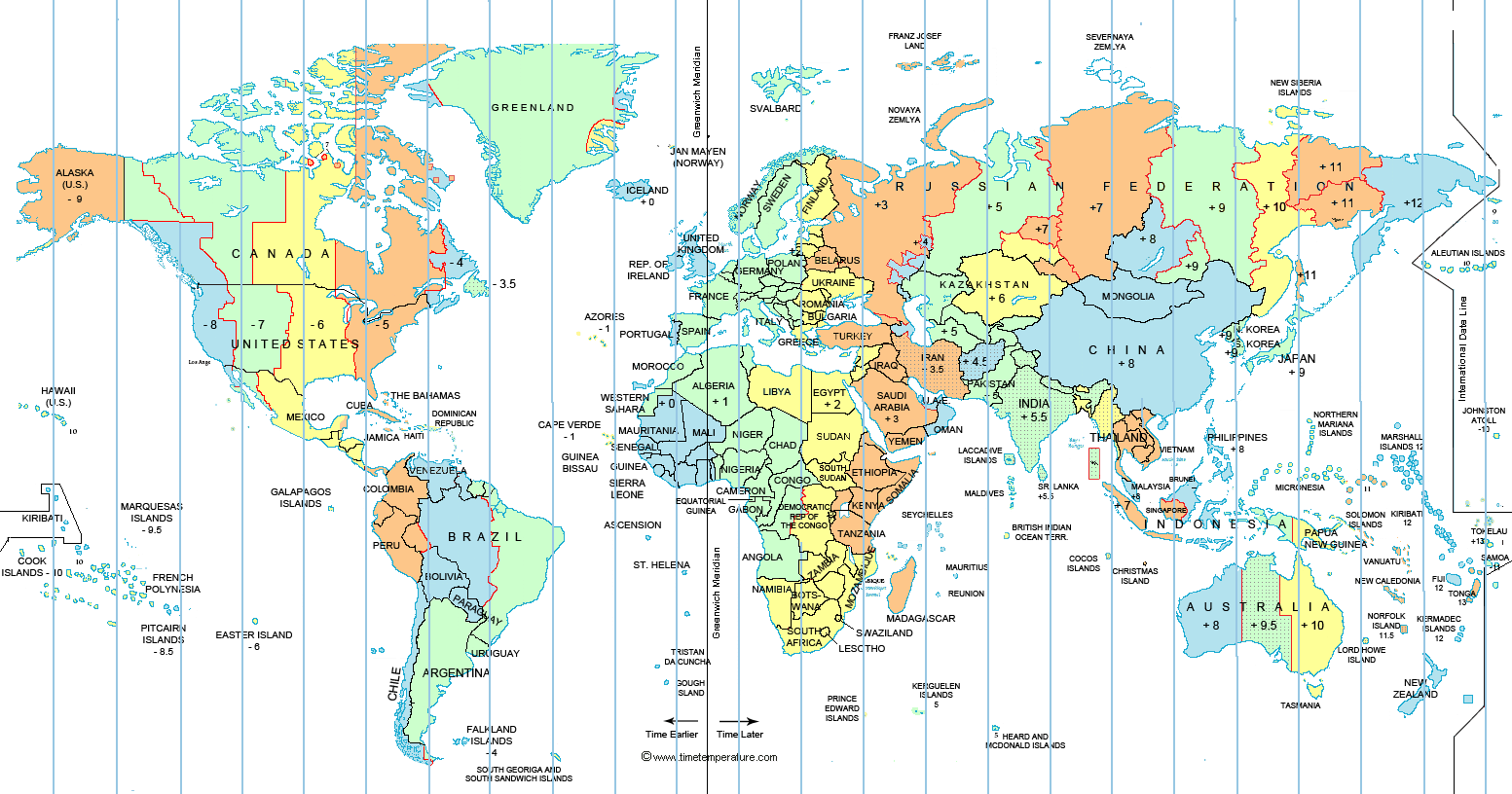
This weekend, the US and several other countries entered into daylight savings time. So, the clocks went back an hour. In China, this did not happen. Now, this is not unusual. Many countries do not have this habit. What is odd about China is that, despite its size, China has only one time zone.

The Chinese time zone is called China Standard Time (internationally) or Beijing Standard Time (domestically). Officially, every part of mainland China, from east to west and north to south, has the same time. (Hong Kong and Macau are exceptions.) This would be like if New York and LA observed the same time zone.  This has been the Chinese government’s policy since 1949. Prior to 1949, China had five time zones.

I haven’t been able to find exactly why the government discarded the old time zones and instituted the current system. The theories I found were that it was either to streamline government operations, make the country appear more unified, exact control over outer regions, or some combination of these factors. Either way, there are parts of China where the sun doesn’t rise until 10am because they are so far west of Beijing. Many of the western regions are home to Chinese minority groups who often feel discriminated against. It seems like some of them also feel like the policy of one time zone adds to this feeling.

Now, some of these western regions, like Xinjiang, have their own, unofficial time zones. In Xinjiang, the local time zone is two hours behind the official time. People do this to be more in sync with the sun. From what I’ve read, this can get confusing because not everyone follows the same custom in these areas.


So, if you’re ever in China, check the local time, check the official time, and good luck being on time. 

__________

__________